Saturday, 13 July 2013

Interactive Design

As i type, tea and giant bag of Doritos in tow, I've taken a quick look around my room to see what gaming peripherals i have lying in my room. Keyboard, mouse, xbox controller and headset. I play a lot of games, probably over 50 hours a week, yet i have no need for any kind of gun peripheral or 3d magic specs to be able to play my games and have fun, so then why have games developers of the past generation decided that gaming peripherals are the way to go? "They're trying to make the experience more realistic!" Well ok but if i wanted to realistically blow someones brains out I would go and join the army or if i wanted Mario kart to feel more weighty I'd go driving like a mad man in my badass 1.2 Clio. I use my gaming more as a tool to escape from this crazy world, because for a few hours everyday i can be a sword wielding maniac or maybe a poshly dressed genius detective or something, rather than being called a "lazy student" or walking to the corner shop just to see that Freddos are now 50 pence (i mean seriously wtf) so in this case "trying to be realistic" doesn't work ."They're trying something new!" i hear you shout. That's all well and good but please make sure your ideas work properly before selling them all over the world. Playing tennis with the Wii was super fun until i realised i could play better slouching on the sofa with a burger in the other hand. Trauma Centre: Second Opinion being almost impossible to play due to how shitly accurate the Wiimote actually was. But then in the corner of my eye i see my sticker covered Guitar Hero controller resting against my wall and i start to remember all the fun i had with it.

http://transitionculture.org/wp-content/uploads/guitar-hero-3.jpg
such a fun game


Maybe I've become cynical in my old age but I never remember seeing a Powerglove or dance mats and thinking "OH BOY I NEED ME ONE OF THOSE", maybe it's because my first gaming experiences came from the computer and the super Nintendo but i think instead of helping immerse myself most peripherals have been really under par and often taken me out of immersion or made me stop playing altogether. Most are expensive, highly gimmicky and don't work as well as a conventional controller.

The 2 unique controllers that i have found actually enhanced games would be the Guitar Hero controller and the new Wii U gamepad. I am going to help developers here and break down why these have worked so if they decide to make their own "unique" controller, if they read this little list, it will be a hit with all the kids. So here we go:

  1. Accuracy

    Both of the controllers are highly accurate. The guitar controller uses simple switch mechanism for the plectrum which is reliable and feels authentic. i never felt that i failed on a song (a rare occurrence of course) due to the controller not responding. The Wii U gamepad is a much more accurate machine than its predecessor's, with much better accelerometers and gyroscopes that pick up all slight movements accurately. All with a large lovely high res touch screen that is just as reliable as the rest of the remote.
     
  2. Cheap

    You might be thinking, "but its like £40 for a Wii U gamepad and I'm sure the guitars were similar too" but you're wrong because they both came with the game/console. They also don't need you to buy any add-ons to play a different game mode or game unlike the Wii motion plus which required people to spend extra money to make the Wiimote as accurate as it should have been on release.
    stupid motionplus


  3. Ergonomic

    I mean i know its not hard for the guitar controller to have gone wrong but some peripherals are just outrageously idiotic in their design. Virtual boy being the best example i can think of. What designer thought, lets make our "portable" 3D console a pair of goggles so heavy you can only play them on a table with a stand or by ducktaping the thing to your head. Why not move all the weight to a small bag and just have the screens at the top with a wire connecting them i mean seriously.
http://gamesworldbodmin.co.uk/images/categories/virtualboy.jpg
Nice and "portable"

So to sum up this post, i don't really like peripherals please stop making them.

Sound for Games

Sound design in games has become just as important to a game than graphics in recent years. Its a highly under appreciated job especially as some games would simply be nowhere near as good without the work of their sound designers. Dead space, for example, would almost certainly not be a trilogy if the sound design in the first one not been so incredible. After being forced into playing the first few levels of the Dead Space, i was really shown the power that sound design brings to games. My character was merely walking through half lit hallways but the combination of scratching, monstrous sounds and eerie violin screeching meant that this was the scariest goddamn hallway I've ever been in. The sound being so good during that first part of the game that i was actually slightly disappointed at how unscary the monsters seemed in comparison to the sounds they were making.

http://www.lolbrary.com/content/84/dead-space-39084.jpg
unfortunately only applies to the first Dead Space


Sound for games, i believe can be broken into two catergories. The first being "general soundtrack" and the second being "sound effects". General soundtrack is the overall blanket of sound that games have. The type of sounds that you would sing as you would walk down the street, like the skyrim main theme or the mario theme or something. Although it is generally used as background noise it can be very good for rooting the type of atmosphere the producers are trying to make. Skyrim for example used the main theme tune when you were scuffling with dragons to help the feel of "holy shit i'm fighting a dragon". Sound effects in my opinion is what really gives a game some "real" feeling. The dragon fighting scene for instance with the main Skyrim theme is pretty cool however you aren't all emmersed without the sounds of the dragon's roar or the clashing of metal to dragon scale. The best use of sound effects to create immense emmersion (try saying that five times) would have to be Battlefield 3 by EA.


 A video where the lead audio designer for Battlefield 3 talks about his experiences in making the sound for their games. The most important thing in my mind from this video is the fact that they really had to experience what a battlefield would be like. If you can make an impact on the lead audio designer, make him really feel what its like on the battlefield, then you've already won half the battle of making honest realistic experienced sound.


A video i found about the layering techniques used by the team when making Star Wars Unleashed 2. This technique is used by nearly every game and movie that I've bothered to watch the "behind the scenes" of. In games especially, layering is used to boost the sound above the layers of ambient sounds and music. It helps create sound with more depth and character than the recorded ones. A good example of how layered sounds is used would be from the game League of legends. Rengar is one of the "champions" you are able to play as, a bipedal lion with an affinity for murder is the briefest description of him i can muster. His roar, the subject of layering sound, was created using layers of real lion roars and explosions to make him sound the the big badass character he is .

Wednesday, 3 July 2013

Game engines

Game engines are the foundation on which a game is made on. Every game is built off one. Flash or indie games, although they generally don't use big well known engines such as Unreal or Cryengine,  will have a rudimentary engine built by their programmer in order for the game to be made. Engines, like that of a car, limit how good your game can potentially be. An example comes from when me and my friends ventured into making a flash game during one summer, unfortunately none of us knew how to code so we enlisted the help of someone from the site Newgrounds. We had told him our idea and what we wanted to do but due to his skill level a lot of the basic gameplay elements we needed couldn't be made, we later scrapped the game. Commercial engines such as Unreal, Cryengine and Unity don't have as many limitations as a lowly coder in his bedroom although there are some significant differences between them that i want to talk about in this blog.

Unreal

going by this list of most popular game engines: http://www.moddb.com/engines/top, Unreal is actually the least popular of the three engines i am going to talk about today. Although not as widely used as Unity, The amount of AAA game titles that use Unreal is quite staggering. Gears of war, Batman Arkham Asylum, Bioshock Infinite, Dishonored some good examples of games that use the Unreal engine.
http://trutechnoid.com/wp-content/uploads/2013/04/bioshock-infinite-gameplay-6.jpg
Bioshock Infinite

http://www.geek-badge.com/wp-content/uploads/2012/05/Gears-of-War-3-Getting-Multiplayer-Beta-Dedicated-Servers.jpg
Gears of War 3

Pro's
  • Free student versions (allowing people to learn it before getting into the industry)
  • Depth of field, Bloom, Motion blur, rendering techniques that can help push a game to become more realistic
  •  Better for interior scenes
  • Physics engine is one of the best in the world
Con's
  • Lighting is restrictive in Unreal 3 with only 4 dynamic lights (although Unreal 4 has more, but is next gen)
  • assets can only have a max of 6 material ID's
  • can become quite complex if needed to be changed from a first person shooter

Unity

The most popular game engine on the list but probably the least known. Used on some extremely popular games such as Battlestar Galactica Online and Temple run.
http://battlestargalactica-495.ah.bpcdn.net/media/10012011v2_BGO_shots42.png?__cv=e2aa4756b721e46075567618e1475d00
Battlestar Galactica Online

http://applenapps.com/wp-content/uploads/2012/08/temple_run_retina_ipad1.jpg
Temple run

Pro's
  • Extremely multi-platform with rumours of even google is trying to get it working on Chrome
  • Scripting languages makes it a good choice for people who are not programming gurus
Con's
  • Free version has restricted use
  • No realtime shadows
  • Rendering quality doesn't match up to Unreal or Cryengine
Cryengine

The second most popular of the three, Cryengine is starting to be used more and more for the rendering quality alone, always seemingly next gen. Cryengine has been used on games like Crysis and Ryse.
http://media.edge-online.com/wp-content/uploads/edgeonline/2013/02/Crysis3-31.jpg
The beautiful Crysis 3
http://cdn.3news.co.nz/3news/AM/2013/6/24/302526/RYSE_2.jpg
Ryse coming later this year

Pro's
  • Development is all in real time allowing a faster pipline
  • Engine is extremely strong, allowing for much higher tri counts and texture sizes
  • Lighting is dynamic and easily editable
Con's
  • Not the best for indoor scenes
  • If working on a large scene or level can get very laggy as it is all real time

Wednesday, 22 May 2013

Documentation


I have been tasked with writing a technical specification for a game...so.. here it goes.

Outline

  • An old school Unreal/Quake style shooter with medium to large arena type maps. capable of holding anywhere between 24-64 players. I do not want the game top be rooted in reality and so i want really imaginative guns and perks.
  • PC exclusive
  • Aimed toward 18+
  • I want the main focus of this game to be fun and highly moddable, i want to emphasise the fact that community made maps are welcomed and encouraged, ergo a simplified map editor will be free with the game.
  • Stylised and efficient design similar to Team Fortress 2 to make it accessible to PC owners of all hardware types.
  • New guns and perks are bought from shop keepers throughout the map similar to DOTA 2 or League of Legends, with money coming from killing or assisting in killing enemy units.


Lead Character

  • Characters model is based of a weight system, similar to that in Brink, slim models are faster and more agile but are burdened with less health etc.
  • highly customisable character. Everything from hair to colour of shoelaces can be altered, giving a much deeper connection to the players character.
  • Tri limit can be anywhere from 5000 to 10000 depending on kit chose although texture sizes will be small to help keep the engine running smoothly. Diffuse, normal, gloss and specular maps all used.
  • Character can be customised on the fly between deaths to bring a fun dynamic to the game.

customizable appearances from brink

NPC

  • Shopkeepers from the maps' shops.
  • 3 different variations, all claiming to be brothers of one another but looking rather suspiciously similar.
  • Very quotable, funny and weird. Not someone you want to be around for too long.
  •  reasonably low poly 5000-8000 tris
  • Dota 2's shopkeeper. full of character.

Vehicle

  • One weapon has a controllable rocket that is ridden as a hat tip to the famous scene in Dr Strangelove.
  • A highly damaging AOE explosive outcome at the cost of suiciding.
  • Can be blown up mid flight if the rocket is shot at before it hits a target or terrain.
riding the bomb, Dr Strangelove
 Environment

  • Medium to large in size to be able to hold the requested 24-64 player limits
  • Simple, clean and not overly distracting from the multiplayer experience, much like Team Fortress 2
  • lots of verticality and many different routes to the same point for varied and fun experiences. Making every game a "unique" experience, slight exploration for newer players.
  • Choke points and highly fought for parts of land like bridges or sniper points for intensive action.
  • Keeping within the same fun aesthetic
  • 2 or 3 shops hidden within levels for buying weapons. possible neutral zone to prevent camping those spots. 
 Props

  • Simple, tri effective props dotted all over the map for added cover and to help populate the map.
  • Not overly distracting or overly detailed, so players can focus on the multiplayer action.
  • Health and ammo pickups, because regenerating health is stupid.
  • Team Fortress 2 again is a very good example.

http://www.teamfortress.com/images/posts/alpine_concept_1.jpg
superb example of simple, yet populated multiplayer map

Level Design


Level design in its most boiled down form, is the process of making a playable environment from concept art and ideas. The role of a level designer is often just whiteboxing a level to so it can be test played before it moves on to be "set dressed". Level editors or game engines are the tools of the level designer.

The Whiteboxing process level designers use is a quick time efficient way of getting ideas out. The use of untextured simple geometric shapes is most common but some companies like valve for example would use a different texture for floors or walkable terrain and separate texture for walls or other immovable untraversable objects. Much like concept art, level whiteboxing is often used as a stepping stone to push idea generation and to test if ideas would actually work in a game.

                           A simple whitebox made in UDK that could be used for play testing.

During, before and sometimes even after the whiteboxing process the designers should be thinking about the various gameplay elements that would be added. Things like spawn points, cover, ammo or health pickups (although thanks to magical health regenerating systems this happens a lot less in modern games). with the whitebox and play testing the designers are able to test to see if these components work well together.

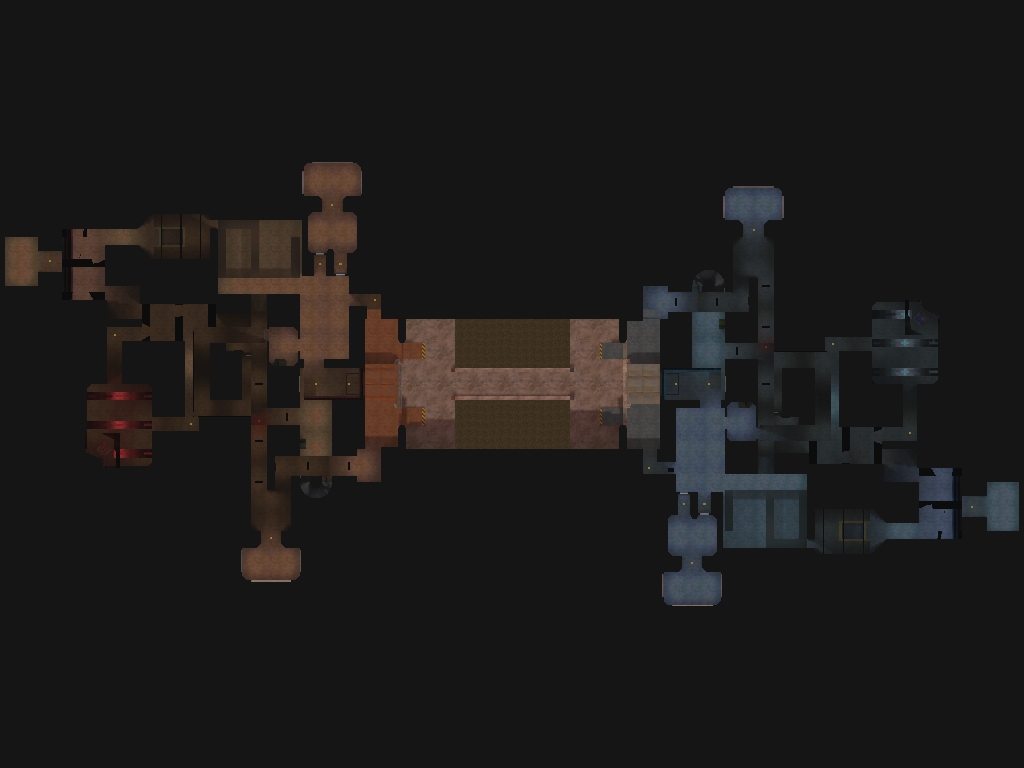
One of my favourite maps of all time would have to be 2fort on Team Fortress 2 by Valve. I believe this is one of the best maps in the world as it melds verticality, different access points and fairness all under a big cloak of aesthetic loveliness.

                                 Here we can see a top down cross section of the map 2fort.

From the start you can see how each side is colour coded based on what team you happen to be on. Although you might think this is dull and stupid, its actually extremely important as the game can get rather hectic at times and needing to quickly establish which side to run to to get your health pickup can be the difference between virtual life or death. Luckily the nice guys at Valve made the colours opposites, blue and orange, so they stand out and its easy to recognise the different bases from each other giving the player visual cues to help them out.
You can see by the cross section, that the map is actually mirrored. this is an easy way a level designer can make sure there is absolutely no unfairness to a multiplayer map as both teams will have the same sniper spots etc.
Another element i love about this map is the verticality. It forces the player to be more aware of his/her surroundings as you could be jumped by a soldier rocket jumping up from below or even a sniper shooting you from up high, making the game more tense/fun without having to add any new gameplay mechanics, a simple and effective technique in making any multiplayer level more fun.

                                The awesome visual style helps make this level even cooler.

Tuesday, 21 May 2013

Composition and making things look pretty

As the task tells us composition is "The arrangement of elements within an image according to established art principles". So to have a good understanding of composition it's also important that we have a good understanding of the "established art principles" right? right. Well there are 6 main art principles; colour, line, shape, value, texture and volume. Each with hundreds of sub genres of principle and hundred of years worth of experience behind all of them, so I'm only going to talk about a couple.

Value 


In my mind this is the most important of all art principles. Value could probably cover volume too but they're slightly different. Value is often described visually by a scale with varying shades of gray arranged between black and white, but in reality its the way in which the artist can make a 2D image look as if it is three-dimensional. Whenever you seen an artist rendering a ball or box in just black and white they're usually practising their value skills


A rather crude rendering of a ball and a value scale to show the point.

Colour

Colour is a very important matter as i feel thats where a painting gets its emotional value. Artists like Rothko have explored how colour can change someones mood by painting massive canvas's with a few colours on, many people when confronting one of rothkos work are overcome with a sombre feeling. Personally, when i stood in front of a Rothko piece i didnt really feel all that much although i could see why people felt the way they did. I feel colour can really change a piece and it is important to understand why.


 The Rothko piece i was lucky enough to see.

Two of the main art principles that have so much depth to them that i barely even scratched the surface of what they intale, so go read about them yourself! Ultimately though, composition is the placement of these art principles in the scene. Its often used to devistating effect by digital artists that are seemingly able to control your eyes. Composition is also important as you can tell the reader scale through placement of the "camera" or viewers eye.


This piece by kekai kotaki for example. The camera is relatively low looking up at the characters and it really pushes the drama of the picture and also the scale of the giant worm monster chasing the cowboys.

I only know of a few rules of composition but i am sure there are many more. The few i know are;

Rule of thirds - making sure there is a point of interest in each third of the frame
Differential focus - Blurring parts of an image to force focus, much like the eyes do naturally
Rule of odds - Using an odd number of subjects to a scene to make it more visually interesting.

Planning and concepting

"All projects should show a progression from initial ideas to final outcomes." The dependence on good planning is essential if a good game is to be made in my opinion. Planning requires forward thinking and good organisational skills. Concepting is a tool used during the planning stage to help people visualise the idea you are wanting to work towards. it is an extremely useful tool that helps a teams' mind work in sync, and is also a useful tool to use when working on personal projects, helping you to finalise ideas that you might have had, giving you a platform to go on and create further more interesting ideas.

Planning comes in many different ways for different ideas or parts of a game. Planning a cutscene for example could be done through the use of storyboards, rough sketches that outline how the scene will plan out, a very cheap and time effiecient way of planning a cutscene through.

http://www.cecilkim.com/portfolio_images/E3%202008%20Storyboard%201st%20comp(1)(2).jpg
A storyboard by Cecil Kim for the God of War series

Another very helpful way of planning for idea generation amungst other things is using moodboards. Moodboards or "brain farts" as i like to call them are basically where you collect a bunch of pictures/bits of writing/colours or pretty much anything and bring them together. Its useful for when you need to help concrete an idea or even serves pretty well as a rudimentary piece of research.
 
This type of planning is often used by fashion students and profesisonals.

Personally, i find that i'm pretty bad at planning ahead and it's quite obvious from my work. I've found that alot of times i make concept art for the purpose of looking pretty rather than for helping me persue the idea into a more detailed and well thought through final outcome. However unlike me games companies would simply fail without great planning and concepting teams, one example of great concepting within games would be Guild Wars 2 by ArenaNet.

ArenaNet used the concept art made by their amazing team of artists to help promote the game and ultimately helping the game Guild Wars 2 become a major success. They blast open the doors of the MMO scene and took the world by storm during release. The art style of Kekai Ketaki really pushing the game forward.

The concept work is not just used for the planning stage of the game but was also used to help tell stories within the game through animated versions of the concept art.


some of the works used to help promote the game, they were even used in the game for loading screens.